Dataset: American Foulbrood Germany
Dataset tables
| Table | Description | Rows | Data Points | Downloads |
|---|---|---|---|---|
Supplemental Files
Any supplemental files, not containing data.
| File Name | Description | File Details | ||
|---|---|---|---|---|
|
|
Dataset Report
|
This file contains in detail the structure of the dataset.
|
This is a generated file.
|
Abstract
This are the cases of American FoulBrood (AFB), which is a bacterial disease of honey bee brood caused by the spore forming bacterium Paenibacillus larvae. This dataset has been obtained from the German Reference Laboratory of Bee Diseases.
Executive summary
Data overview
The dataset is provided by the Friedrich-Loeffler-Institut (FLI), the German Federal Research Institute for Animal Health, through its publicly accessible TierSeuchenInformationsSystem (TSIS), available at https://tsis.fli.de/cadenza/. Since 2011, the German National Reference Laboratory (NRL) for Bee Diseases has been housed at the FLI, and since June 2017 the NRL also carries the mandate of the WOAH Reference Laboratory for American Foulbrood (Paenibacillus larvae). The subject area covered is the official epidemiological surveillance of American Foulbrood (AFB), a notifiable bacterial disease of honey bee brood in Germany. Outbreak notifications originate from the competent state-level veterinary authorities, who report cases digitally to the Federal Ministry of Food and Agriculture (BMEL) via the TierSeuchenNachrichten (TSN) application; these notifications form the underlying data source of TSIS. Geographically, the data covers the entire territory of the Federal Republic of Germany, with cases attributed to all 16 federal states (Bundesländer) and their constituent districts (Kreise). The temporal coverage of the dataset as extracted spans confirmed AFB outbreak events up to 18 December 2024, with the earliest records reflecting the start of systematic digital TSN-based reporting.
Data value
American Foulbrood is one of the most economically and ecologically damaging bacterial diseases of managed honey bee colonies worldwide, and in Germany it is a notifiable disease under the Bienenseuchen-Verordnung (BienSeuchV), obliging beekeepers and veterinary authorities to report confirmed outbreaks without delay. The collection of this surveillance data serves multiple critical purposes: it enables the competent authorities to monitor disease incidence in real time, trigger statutory containment measures (movement restrictions, colony destruction, and zone quarantines), and fulfil national and international reporting obligations. The NRL works in close collaboration with the European Reference Laboratory for Honey Bee Health and with regional research institutions of the German federal states. For the scientific community, this dataset offers a longitudinally consistent, administratively validated record of AFB outbreak dynamics, making it uniquely suited for epidemiological trend analysis, spatial risk modelling, and assessment of the effectiveness of regulatory interventions over time. For civil society and policy actors, it provides objective, official evidence to inform pollinator health policy at both national and EU level.
Data description
The dataset consists of a single flat-file table extracted from the TSIS/TSN database in CSV format, with a file size and row count to be confirmed upon full file access. It contains nine columns capturing the key administrative and epidemiological attributes of each outbreak site record: a unique outbreak site identifier (Seuchenobjektkennung), the detection date (Datum Feststellung), the lifting date (Datum Aufhebung), the animal species (Tierart), the housing type or production system (Kulturform), the federal state (Bundesland), the district (Kreis), and the outbreak site status (Status Seuchenobjekt). The data are categorical and temporal in nature, with no quantitative colony-level or molecular variables included. Records represent individual confirmed AFB outbreak sites rather than individual colonies or apiaries. Rows without a lifting date correspond to outbreak sites that were still under restriction or pending closure at the time of data extraction (7 March 2025). The dataset does not include laboratory diagnostic metadata, ERIC genotype information, or beekeeper-level identifiers.
Data application
This dataset has a broad range of scientific, regulatory, and applied uses. At the epidemiological level, it can be used to characterise the spatio-temporal distribution of AFB outbreaks across Germany, identify hotspot districts or federal states with disproportionately high case burdens, and analyse long-term incidence trends to evaluate the impact of surveillance policy changes. The detection-to-lifting duration derived from the two date columns enables analysis of outbreak resolution efficiency across administrative jurisdictions. The housing type variable (Kulturform) allows differentiation of outbreak risk profiles between conventional managed colonies, nucleus colonies, and other production systems. Linkage to external datasets — such as the DESTATIS district register, EUROSTAT apiary census data, or land-use/landscape composition datasets — would enable multivariate risk factor analyses. At the policy level, the data directly informs the evidence base for revising the Bienenseuchen-Verordnung and for Germany's reporting obligations under EU Animal Health Law (Regulation (EU) 2016/429). It is also relevant to ongoing debates around harmonised AFB surveillance frameworks within the EU Pollinator Hub and comparative cross-Member State disease burden assessments.
Unresolved issues
Introduction
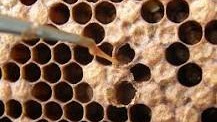
American Foulbrood (AFB) is a highly contagious and destructive disease of honey bee (Apis mellifera) brood caused by the spore-forming bacterium Paenibacillus larvae. Depending on the ERIC genotype, P. larvae kills the majority of larvae either before or after cell capping: ERIC II strains cause larval death before capping, resulting in a spotty brood pattern readily detected by nurse bees, whereas ERIC I strains cause post-capping death, leading to sunken or perforated cappings and the characteristic ropy, coffee-brown, semi-fluid mass that adheres to cell walls and dries into a hard scale. The spores of P. larvae are extraordinarily resistant to environmental degradation and remain viable in hive material and honey for decades, making AFB effectively incurable in the field and necessitating the destruction of affected colonies and equipment in most regulatory frameworks.
In Germany, AFB is a notifiable (anzeigepflichtige) animal disease governed by the Bienenseuchen-Verordnung (BienSeuchV, consolidated version of 3 November 2004, as amended). The German National Reference Laboratory for Bee Diseases, located at the Friedrich-Loeffler-Institut (FLI) since 2011 and designated as a WOAH Reference Laboratory for AFB since June 2017, is nationally responsible for coordinating diagnostic standards and methods for notifiable bee diseases, working in close collaboration with the European Reference Laboratory for Honey Bee Health and the regional research institutions of the German states. Confirmed outbreaks are mandatorily reported by the competent district veterinary authorities to the Federal Ministry of Food and Agriculture (BMEL) via the Tierseuchennachrichtensystem (TSN), a nationwide electronic system for the registration of all notifiable animal diseases in use since 1995, developed at the Institute of Epidemiology in Wusterhausen and used at district, state, and federal levels. The aggregated data are published openly through the TSIS platform (https://tsis.fli.de/cadenza/), providing a transparent, regularly updated epidemiological record of AFB occurrence across all 16 German federal states.
Despite the long-standing surveillance infrastructure, systematic quantitative analyses of AFB outbreak dynamics at the national scale — including temporal trends, inter-regional variation, and outbreak resolution efficiency — remain limited in the peer-reviewed literature. The present work addresses this gap by analysing the official TSIS/TSN surveillance dataset, characterising the spatio-temporal patterns of AFB in Germany and identifying factors associated with outbreak persistence and geographic clustering.
Material and methods
Data acquisition
Outbreak data on American Foulbrood in Germany were obtained from the TierSeuchenInformationsSystem (TSIS), the official animal disease information platform of the Friedrich-Loeffler-Institut (FLI), accessible at https://tsis.fli.de/cadenza/. TSIS is updated once per night (approximately 03:00 CET) and reflects the state of the previous day; it is fully accessible without login, authentication being reserved for administrative purposes only. The dataset was extracted on 7 March 2025 and contains all AFB outbreak site records registered in the TSN system up to 18 December 2024. The data are sourced from mandatory notifications submitted by the competent veterinary authorities at district level (Kreisebene) in accordance with the Bienenseuchen-Verordnung and EU Animal Health Law (Regulation (EU) 2016/429, Article 19–20).
Data preparation
The extracted dataset is a single tabular CSV file containing nine variables per outbreak site record: a unique outbreak site identifier (Seuchenobjektkennung), date of detection (Datum Feststellung), date of lifting of restrictions (Datum Aufhebung), animal species (Tierart), housing/production type (Kulturform), federal state (Bundesland), district (Kreis), and outbreak site status (Status Seuchenobjekt). Each record represents a single outbreak site event, not an individual colony or apiary. Records lacking a lifting date at time of extraction were considered as ongoing or unresolved outbreak sites.
Data validation
n/a
Data analysis
Data were imported and processed using Python (pandas library). Date variables were parsed to ISO 8601 format; outbreak duration was calculated as the interval in days between Datum Feststellung and Datum Aufhebung for resolved events. Spatial aggregation was performed at both district (Kreis) and federal state (Bundesland) level. District identifiers were cross-referenced against the official DESTATIS district register (Kreisschlüsselverzeichnis) to assign NUTS-3 codes and enable linkage with external administrative and apiary census data where relevant. Descriptive statistics were computed for outbreak frequency, seasonal detection patterns, and resolution duration. Temporal trend analysis was conducted on annual case counts. All analyses were performed in Python 3.x; figures were generated using matplotlib and seaborn.
References
-
Friedricht Loeffler Institut Startseite-TierSeuchenInformationsSystem. [2025-3-7] tsis.fli.de
Data Providers

Other
Reviewed by
Simòn Delso Noa as Managing directorSupervised by
Simòn Delso Noan/a